
Peter Scholleck Artist at a Glance
by J. Susan Isaacs, Ph.D., M.F.A., curator and art historian
A self-taught modernist artist, Peter Scholleck created a large body of work in a relatively short time period. He developed as an artist without the structure of art school, nor as a member of any critique group, nor by taking private lessons. He experimented with many different styles, eventually developing a sophisticated personal approach that places him within the contemporary art scene of his time, and which remains relevant today. He learned drawing and painting by looking at images in art publications and through constant practice. American artists received art journals that covered not only American art but also European art. ARTnews magazine was one of these and it was very popular.
Scholleck was familiar with ARTnews magazine, initially most likely through obtaining or being gifted a cache of 1940s back issues (he served in the Pacific from 1943-46), and later through a subscription. He also visited the Baltimore Museum of Art, which opened its Cone Collection of modern art to the public in 1950. He may have visited other museums too, although there is no specific record of this. He also owned several art history books.
Works such as Seascape, 1947, and Snowscape, 1955, indicate that Scholleck agreed with the simplicity of composition and form utilized by such American artists as Arthur Dove and Marsden Hartley. Hartley’s late work, such as Mt Katahdin Northeast Piscataquis, ME., 1939-40, especially demonstrates a sympathy for broad brushstrokes and simplified compositions that we see in Scholleck’s early work.
It is also apparent that at various periods in his career, Scholleck embraced or experimented with the modernism of Pablo Picasso, Henri Matisse, Georges Rouault, the German Expressionists in the circle of Wassily Kandinsky, Die Brücke German Expressionists, Surrealists, and the Abstract Expressionists.
In 1963, Scholleck created an important painting, Nude, which demonstrates his later approach to painting that involved the buildup of layers where he produced paintings with a thick impasto surface. He created an 18-step process to do this. Another work that demonstrates his fascination with the relationship between composition, content, and texture is his 1965, Last Supper.
Scholleck was fascinated by the relationship between human beings and the greater world. This is most clear in a series he produced in 1965 entitled, Time, Space and Matter. To some extent, the topic was likely suggested to the artist through the space program taking place and in the news at that time. They are important paintings in which he integrates contemporary events, scientific theory, and human figures either showing them directly or positioning us as the body viewing this enormous expanse, suggesting new ways for understanding our relationship with the universe.
Scholleck continued to paint through 1967, creating some very large, impressive works before his death in 1969. He constantly experimented with style and materials. This exploration began initially when he taught himself how to paint but eventually resulted in a mature practice based on an inquisitive nature and innate intelligence. Had he lived longer, no doubt he would have continued to make remarkable works.
Learn more about Peter Scholleck below.
Peter Scholleck in Context
by J. Susan Isaacs, Ph.D., M.F.A., curator and art historian
Peter Scholleck was a self-taught modernist who produced approximately 250 works during his artistic practice of about 20 years. Through careful observation of individual drawings and paintings, we can come to some conclusions regarding his development as an artist which he accomplished without the structure of art school, nor as a member of any critique group, nor by taking private lessons.
While he showed his work in a few regional art fairs, he shaped his own artistic vision separate from classes or interaction with other visual artists.(1) Most self-taught artists in the 20th century were folk artists or outsider artists, not modernists. However, Scholleck was an extremely intelligent man who spoke five languages and who received a superior education as a youth in Germany. He experimented with many different styles, eventually developing a sophisticated personal approach that fits well within the contemporary art scene of his time, and which remains relevant today.
He seemed to have learned painting from looking at images in publications and through constant practice. He owned several art books, including a beautiful 1944 survey of the National Gallery of Art collection with full-page color illustrations given to him by his wife just two years after its publication. It is a walk through the western history of art from Duccio to Picasso, Raphael to Van Gogh and Manet to Cézanne. He also owned a human anatomy book organized by Reginald Marsh, (1945), and a small, but well-illustrated book on the work of Vincent Van Gogh (1960) gifted to him by his brother; indeed, he painted an ode to Van Gogh in 1961, Old Man in a Wheat Field, For Vincent. An even earlier untitled work from 1960 also suggests Van Gogh and wheat fields. In the same period he produced a large highly textured image of flowers that no doubt is something of a nod to Van Gogh as well.
Scholleck was familiar with ARTnews magazine, initially most likely through obtaining or being gifted a cache of 1940s back issues (he served in the Pacific from 1943-46), and later through a subscription. He also visited the Baltimore Museum of Art, which opened its Cone Collection of modern art to the public in 1950. He may have visited other museums too, although there is no specific record of this.
Many American museums were adding works by late 19th and early 20th century modern European artists such as the Impressionists and Post Impressionists, and some were purchasing works by Picasso and other abstractionists. The Whitney Museum of American Art held an exhibition, Abstract Painting in America in 1935 with the work of 65 artists. One important independent organization, American Abstract Artists, AAA, was founded in 1937. However, they eschewed Surrealism and Expressionism, preferring geometric and biomorphic abstraction. The public and most critics were generally resistant to abstract art for several reasons from its association with European art (as opposed to American art) to its sometimes connection to artists who were involved with socialism or communism.
In the 1940s and 50s, art schools in the United States were largely based on traditional figure studies and painting still life and landscape scenes. Learning contemporary abstraction generally occurred by seeing the works of artists who were experimenting with these styles in gallery exhibitions or by being with a group of artists who practiced these methods. Some took classes with Hans Hoffmann, a German artist, who arrived in the US before WWII. He presented the ideas and imagery he had seen in Europe as part of a circle of avant-garde artists. Additionally, there were artists who, with the help of the Emergency Rescue Committee (IRC) and the Museum of Modern Art, escaped the Nazis during WWII and made their way to the United States, including, to name just a few: Max Ernst, André Breton, Marcel Duchamp, Max Beckmann, Fernand Léger, Yves Tanguy, Piet Mondrian, and Marc Chagall. Modern styles ranged from Post Impressionism to Fauvism, various forms of Expressionism, Cubism and its variants, including forms of geometric abstraction, Bauhaus, and Surrealism. Some of these artists stayed in the US after the war. Many of them had exhibitions while in this country and several of them taught classes too.
American artists received art journals that covered not only American art but also European art. ARTnews magazine was one of these and it was very popular. While still including many historical articles, the publication gradually added illustrated writings on such artists as Cézanne, Gauguin, and Van Gogh. A study of ARTnews from 1940-1968 demonstrates that the publication also increasingly reviewed more contemporary exhibitions by living artists, not only in New York City, but in other cities around the United States too. They also published feature articles on many of the modernists such as Henri Matisse.
Some of the images in ARTnews can shed light on SchoIleck’s development. In the fall of 1943, a full color plate of Claude Monet’s, Rocks of Belle Isle, 1886, was presented in ARTnews. No doubt, it demonstrated to Scholleck that highly textured brushwork and an emotive interpretation of a scene from nature was acceptable even before receiving the book on Van Gogh. In Seascape or The Sea, 1947, we see a correlation between Scholleck and other 20th c. American artists such as Marsden Hartley and Arthur Dove whose works were in the pages of ARTnews as well. It is possible that he might have seen their work at the Phillips Collection in Washington, D.C. Examples of such paintings as Off To the Banks, 1936-1938, by Hartley, and Morning Sun, 1935, by Dove share a similar sensibility with Scholleck’s own views of nature. Another possibility is that he independently came to some of the same conclusions.
Scholleck clearly agreed with the simplicity of composition and form utilized by these artists. He may have learned about the textured paint and broad brushstrokes employed especially by Hartley through ARTnews if not in person. There is a sense of immediacy to Seascape. One of the aspects of much modernist art was the value placed on children’s and folk art, which these artists utilized for their own purposes. For instance, three paintings by Scholleck, his 1947 Seascape, the 1954 “Ach, the beautiful colors of the trees” “I.N.,” and the 1955 Snowscape, are in tune with the simplified composition and broad brushstrokes of Hartley’s, Mt Katahdin Northeast Piscataquis, ME., 1939-40, featured in ARTnews magazine in November of 1944.
In 1948, Scholleck suggested an epiphany with the painting titled “BREAKTHROUGH” PICASSO. It is not a cubist work but rather references the earlier blue and rose periods of Picasso’s career. The title underscores this inspiration, Picasso’s 1901 Le Gourmet, a work Scholleck would have seen through its full-page color illustration in ARTnews in May 1943.(2) However, Scholleck’s brushwork remained expressive. Indeed, most of his mature work, though not all, demonstrates an affinity for expressionist painting. It is apparent that at various periods in his career, Scholleck embraced or experimented with the modernism of Pablo Picasso, Henri Matisse, Georges Rouault, the German Expressionists in the circle of Wassily Kandinsky, the Die Brücke German Expressionists, Surrealism, and Abstract Expressionism. He also looked at the works of Paul Cézanne and Vincent Van Gogh. Essentially, over time, Scholleck absorbed what he saw and synthesized it to create his own highly original works.
For instance, Scholleck’s My Friend Pumpian, 1954, presents a portrait that shares some similarities with those by another Jewish artist, Chaim Soutine. Soutine’s Woman Seated in Armchair of the same year combines expressionist brushwork and bright color with a flattened cubist space and angularity. Soutine appears in the pages of ARTnews from time to time; a landscape painting, View Overlooking Céret, by him, entered the Baltimore Museum of Art collection in 1960. Scholleck’s expressionist vision with thicker paint and heavily textured surfaces begins to appear in the 1960s. An example of this is an untitled work that looks like a floral bouquet but also reads very much as a landscape.
Another expressionist artist featured several times in the magazine is Rouault. Rouault’s The Wounded Clown, 1939, appeared on the cover of the April 15-30, 1945 issue of ARTnews and a color image of his Three Judges, 1913, was included in an article on the artist in that same issue. Even earlier, one of Rouault’s most well-known works, The Old King, 1916-1936, was included in a color plate in an April 1941 issue of ARTnews. Such works by Scholleck as Rabbi, 1954, and Clowns, 1963, present similar subjects with like introspective and emotive characters. Equally important is the fact that the BMA, through the gift of sisters Claribel and Etta Cone, includes some important works by Rouault, especially the painting Two Clowns c. 1935.
Although Scholleck was Jewish, he was not religious. Nonetheless, over time he depicted a few Jewish subjects. These were not Judaica; he did not make religious objects but a few paintings and drawings especially of rabbis. The one closest to Rouault’s painterly, expressionist style is the 1954 Rabbi holding the scrolls of the Torah. He wears the traditional white high holy day garb for a Jewish religious leader like a cantor or rabbi which typically includes the kittel (robe), a tallit (prayer shawl), and the kippah or as in this case, a mitre-style hat derived from the mitznefet, the biblical priestly turban that became a part of the Ashkenazi tradition for the High Holy Days.
In his mature works of the 1960s, Scholleck returned to the subject. A drawing on paper of 1964 depicts a bearded rabbi with tefillin on his forehead and a tallit over his head. This is what Jewish men who are more religious wear when they pray. It is an excellent drawing with a dramatic use of black and white contrasts. He also depicted Moses in a less complex undated charcoal drawing, identifiable by the figure holding the tablets of the 10 commandments.
His most ambitious work in this regard is The Rabbi, the Priest, and the Layman. The subject builds upon Rouault’s introspective characters, but in Scholleck’s later Abstract Expressionist style, and the topic seems more philosophical as if the three figures are in an existential conversation. Existentialism is a philosophy that influenced several of the Abstract Expressionist artists. It became connected to the anxiety of a post WWII world— to the atomic age and the realization of human beings’ destructive capabilities. Here three figures, two of them religious leaders, one an ordinary man, meet in a compressed space, perhaps sharing this modern burden. Scholleck’s daughter, Eileen Scholleck Koenigsberg, recalls that he shared many philosophical and existential conversations with his friend Donald Menaker and his wife’s maternal uncle, John Cain.
A related subject that appears in some of his later works is that of Jesus. Images of Jesus began appearing in paintings by prominent Jewish artists in the 19th century as important Jewish writers and artists began to examine Jesus as a historical figure rather than a symbol of antisemitic Christianity.(3) In the 20th century, artists connected the subject of his resurrection to Zionism and the establishment of modern Israel. But for the Russian/French Jewish artist, Marc Chagall, exiled in New York City during the second World War, the theme was about Jewish suffering.(4) A photograph of Chagall was included, alongside that of other exiled artists, in a two-page photo spread, “Artists in Exile...Artists in Captivity,” in the November 1941 issue ARTnews. Chagall’s distress with Antisemitism, Fascism, and the Holocaust informed his view of Jesus, particularly the crucifixion, as a symbol of the persecution of the Jews. One of his most famous works from this period is The Crucifixion in Yellow which includes specific references to a contemporary event, the February 23, 1942 sinking of the Struma, with the loss of nearly 800 Jewish refugees who were aboard. This disaster was documented worldwide in newspapers of the day.(5)
Scholleck’s own direct experience as a German Jew in Munich in the 1930s with the rise of Nazism and then learning more about the Holocaust during and following the war, also might have motivated him in 1963, to create two paintings on the topic within the context of the modern Jewish interpretation of Jesus. First, he produced an expressive crucifixion image titled, Jesus in 1963. This work recalls expressionist images of the same subject by such artists as Oscar Kokoshka and Georges Rouault, both of whom had crucifixion works presented in ARTnews. Indeed, Scholleck might have even seen a May, 1953 article by Edgar Wind entitled “Traditional Religion and Modern Art,” which included a full-page color image of Rouault’s Christ Mocked by Soldiers of 1932 and a small black and white photograph of his crucifixion painting of 1918 placed next to Picasso’s 1933 drawing Relic of Bones, Crucifixion, 1933, Picasso Museum, Paris).
Scholleck’s image of Jesus is clearly the crucifixion scene, apparent from the pose, but the fact that the title is the name of the person being depicted and not the event is in keeping with a more modern, Jewish interpretation of the scene. Brushwork helps define the figure, with facial features that almost echo the shape of a cross. The application of paint is fairly violent with quick brushstrokes that in some places appear dragged across the surface. Color is largely reduced to shades of brown and black. These techniques result in an emotive painting of a suffering human being.
The year that Scholleck created his own interpretation of Jesus, is also important in that it is when Dali’s 1955, The Sacrament of the Last Supper, formally became part of the National Gallery Collection. While it was on long term loan beginning in 1956, its donor, Chester Dale, died in 1962, making it a permanent gift in 1963. There was much international attention when it first came into the collection, revived again in 1963.
In 1964, Scholleck created one of his most powerful works, a very large, dramatic, thickly painted Last Supper. When asked why this subject, his daughter recalls him replying something like: “If Dali can do it, I can do it.” It is the opposite of Dali’s own highly classical, hard-edged, devoid of emotion painting. Scholleck went in the opposite direction with a sculptural carving out of this last meal with Jesus’s followers, knowing that he will be betrayed by one of them. It is a passionate rendering due to the expressive brushwork which is built up in layers. The light is on Jesus’ face in the center of the composition. Scholleck does not expand the table as in the famous Leonardo da Vinci version nor the Dali presentation, but instead pushes the figures together, almost piling them up upon one another and toward Jesus, creating a tense scene. The scale of the work contributes to the monumentality of the subject. This is a mature work that represents Scholleck’s intellect, but also his interest in material and technique explorations. In 1965, he wrote in a letter to his cousin: “...I feel very strongly that the paintings will not only speak for themselves but are truly original in technique.”(6) However, he also recognized that his recent works were not “really suitable for the average home.”(7)
Throughout his career, Scholleck experimented with various types of abstraction. One early example is an untitled painting he made in 1947, comprised of bright colors and largely biomorphic forms. It seems inspired by Kandinsky’s early nonobjective works such as Black Lines, 1913, depicted in a small black and white image in an April, 1945 issue of ARTnews. Kandinsky connected music with visual art, discussed in the accompanying article, and here Scholleck includes a snippet of a musical score. Scholleck listened to both Jazz and classical music regularly, especially when making art.
There are other paintings related to what was taking place in the early 20th century in terms of Cubism, Futurism, and de Stijl (Piet Mondrian). Scholleck sometimes borrowed elements from different styles and combined them to make his own works. We see this in two elegant works from 1954: Composition Blue vs. Red and an untitled painting whose movement suggests Futurism but with color that recalls that of Kandinsky and Franz Marc.
He continued to explore geometric abstraction in another untitled 1954 painting, the very small Sunshine, 1956, and an untitled 1961 work on paper. These more geometric forms later reappeared but through the lens of expressionism with highly textured surfaces. Two such examples are untitled works from 1966 (here and here). As they became more expressionist, their scale enlarged as well.
Scholleck was inspired by the works of Matisse too, which is not surprising since Baltimore’s Cone sisters were friends with the French artist, collected his work extensively, and left their collection to the Baltimore Museum of Art where Scholleck very likely saw two of its major works, Blue Nude and the Large Reclining Nude. In fact, in 1954, Scholleck made a painting entitled Blue Nude. He turned the horizontal figure vertical and the curving forms of Scholleck’s work seem to owe something to Matisse’s Large Reclining Nude as well. That same year he created a small painting, Dancing Girls, that refers to Matisse’s very large study Dance I, 1909, made for Matisse’s Russian patron, Sergei Shchukin.
The study painting has been in the collection of the Museum of Modern Art, New York City, since 1963, with the final work, Dance II, in the Hermitage Museum St. Petersburg, Russia. It is very likely that Scholleck based his painting on a reproduction of the work. A small black and white photograph of Dance I was depicted in ARTnews in April, 1948. Scholleck may indeed have seen that image, however, there was a major Matisse exhibition that began at the Museum of Modern Art in New York in November of 1951, which included this work. The show travelled to the Cleveland Museum of Art, the Art Institute of Chicago and ended at the San Francisco Museum of Art in 1952. It was accompanied by a catalog with a full-page black and white image of Matisse’s Dance I on page 17.
The catalog cover, both front and back, is full color. In November of 1952, ARTnews featured two articles based on visits to the now elderly artist in Nice (Part I by Georges Salles and Part II by E. Tériade). There are numerous color and black and white images in these articles but not the Dance. The articles, no doubt, were published as a follow up to the important Matisse exhibition. However, Scholleck’s painting indicates that he somehow saw the catalog for what was thought to be possibly the last major gathering of Matisse works before the anticipated artist’s death (which took place in 1954, the same year that Scholleck created his Dancing Girls). Scholleck’s figures are ghostly and not on a blue and green background like in the Matisse painting but instead placed against colorful vertical stripes akin to those that make up the design of the exhibition catalog. The dancers’ body colors suggest more how they appear in a black and white photographic reproduction than in Matisse’s actual painting. Scholleck’s interpretation, while inspired by what he has seen, resulted in a unique work that paid homage to the great modernist artist.
Overwhelmingly, Scholleck preferred an expressive approach as in the earlier discussed, The Rabbi, The Priest and the Layman, 1966. While there are some straight lines in this painting, it is mainly both in subject and style an example of expressive painting that we historically associate with such artists as the German Die Brücke group like Karl Schmidt Rottluff or a later artist such as Max Beckmann, who was featured in an interview published posthumously in March of 1951 in ARTnews. The author, Dorothy Seckler, asked Beckmann if painting could be taught. A headline like that surely must have attracted Scholleck’s attention. Beckman answered Seckler with “Art cannot be taught, but the way to art can be taught.” For Scholleck, we should add: “the way to art can be learned.”
Both The Rabbi, The Priest and the Layman, and Scholleck’s one-year earlier self-portrait relate very well to American Abstract Expressionist work, particularly that of Elaine de Kooning who wrote over one hundred articles for ARTnews and whose work was reviewed in its pages from time to time. Her portrait of President John F. Kennedy, completed in 1963, was discussed in an ARTnews article in the summer of 1964. Scholleck’s paintings have a more subdued palette, but the quickly moving brushwork is a characteristic of much Ab Ex painting at that time and makes him part of a movement that, as indicated by the illustrated exhibition reviews in ARTnews, gradually swept across the U.S. These artists believed that abstract painting should and did have significant meaning though titles were often few and far between. Viewers were to experience the works. Scholleck seems to have followed this course by sometimes providing titles and oftentimes not.
By examining one important painting by Scholleck, Nude of 1963, we can observe the way in which he worked out an image over time. There are three other works also related to Nude. The first establishes the basic format of a figure from the back when it first appeared in his Girl in the Leotard, 1954. At this point she is not nude, and her arms are not raised. The second is an undated drawing, possibly c. 1963, where he returned to the theme, but now with a more fluid drawing of a nude figure, who still faces a corner, but her arms are raised. The third and closest in style and composition to the Nude is a watercolor and oil stick on paper. It is smaller and brightly colored, contrasting with Nude’s essentially life-sized heavily textured black and white image in oil paint and mixed media on linen.
The source for this pose is likely a Degas pastel c. 1895, pictured as a full color plate in the March, 1943 issue of ARTnews. The image was advertising a Degas exhibition at Durand-Ruel Gallery, and through following its provenance, we learn that it ended up in various private collections over the years and ultimately auctioned off by Sotheby’s in 2015 to another private collector. Although Degas made several pastel works of a girl combing her hair, the one depicted in ARTnews is closest to Scholleck’s compositions. Consequently, we can logically conclude that this pastel, illustrated in ARTnews, could only have been seen in person at the Durand-Ruel Gallery, but when Scholleck was in the armed service. He therefore must have viewed it in a back issue of ARTnews magazine and not in person. This tells us something about Scholleck’s methods.
Around 1960, Scholleck began to paint with layers which entailed developing an 18-step process. After stretching the canvas, he applied a ground (gesso is a ground). A charcoal sketch was administered as step 3. Step 6 was for applying what he described as “texture” while steps 8 and 11 were to correct the original texture. He began to apply paint at step 12. He mostly painted oil on canvas board or stretched canvas. Acrylic paint and medium became publicly available in the U.S. in the early 1960s, and were advertised in artist magazines, among them, ARTnews. Oil paint can be applied over acrylic paint and/or gesso if done properly. Heavy body acrylics can be used for impasto applications. Without scientific analysis we can’t say what Scholleck employed to create texture, but according to his own notes, we know that it became a part of his process in the 1960s, and that he did employ gesso for his ground. What is important is that many of his works from his last years demonstrate a love of impasto which often emphasized content—that there were layers of not only paint but also meaning. The black and white painting of the Nude brings with it both ancient history and contemporary ideas about beauty and form.
The basic compositions of the nudes discussed above are clearly inspired by the Degas pastel, but what else was Scholleck looking at? How was he declaring himself as a contemporary artist? These images did not suddenly emerge. For instance, in the 1950s, he was flirting with Cubism for images of nude females. In an untitled work from that decade, Scholleck broke up the nude female form and employed geometric shapes deconstructing the body. In a later untitled work of two figures from 1956, he continued this exploration, and angular figures appear in a drawing of that same year.
Possibly he saw the study Nude with Drapery, 1907, at the Baltimore Museum of Art when it came into the collection in 1950. Since the Nude with Drapery was a work on paper it is less likely that it was on public view; however, he would have seen the color image of Les Demoiselles d’Avignon in the April, 1953 issue of ARTnews. It remains shocking, even today. Here the central figure has her arms raised in a similar but reversed pose of Degas’s Woman Combing her Hair. Scholleck probably also saw an image of Willem de Kooning’s Woman 1, 1950-52, depicted in color in the March, 1953 issue of ARTnews. By synthesizing his observations of the nude by Degas, Picasso, and de Kooning, as well as the expressive brushstrokes and the impasto of many of the Ab Ex painters, Scholleck made a bold declaration of his own place in contemporary art. He did this largely privately, painting at every opportunity in his studio space, first in the family’s two-bedroom apartment and then from 1955, in the basement of their split-level home. It is an amazing achievement.
In 1965 he produced a series, Time, Space and Matter, which refers to an idea in modern physics linking time, space, and matter to the structure of the universe.
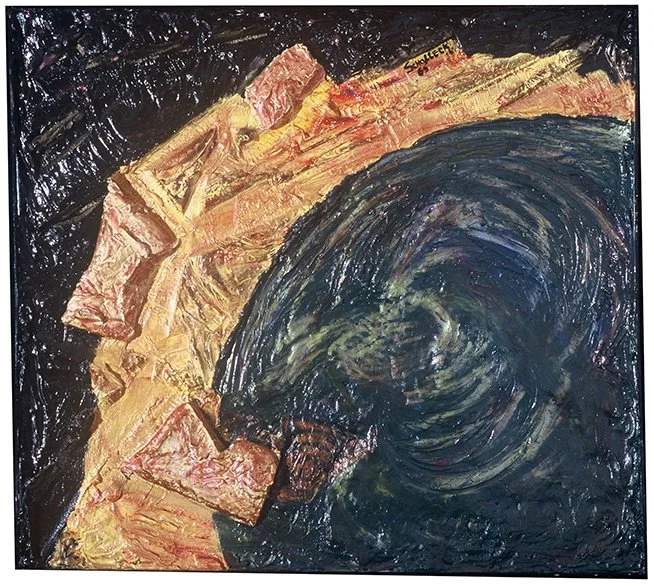
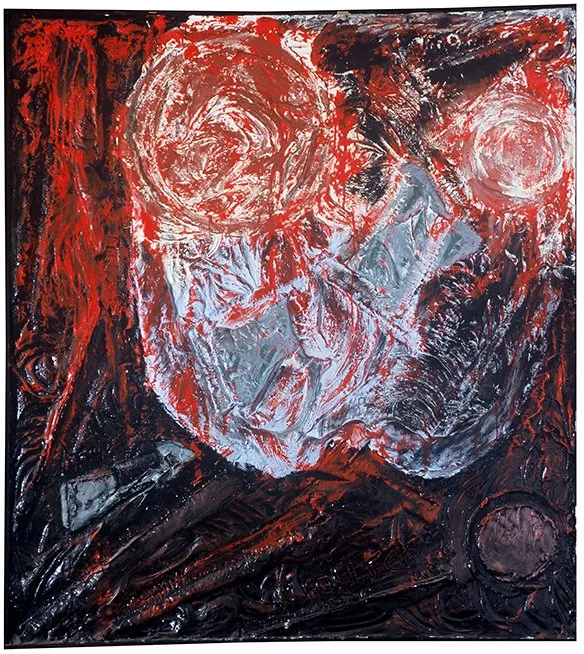
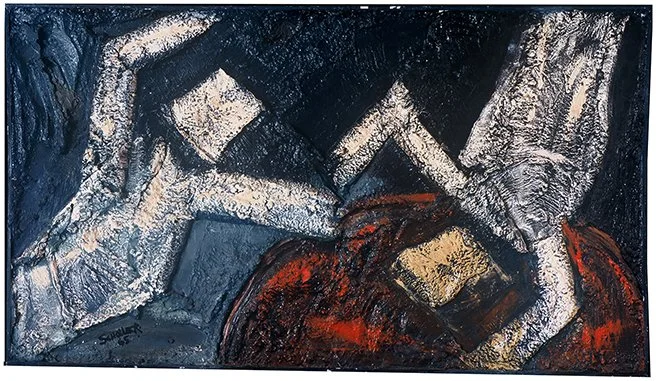
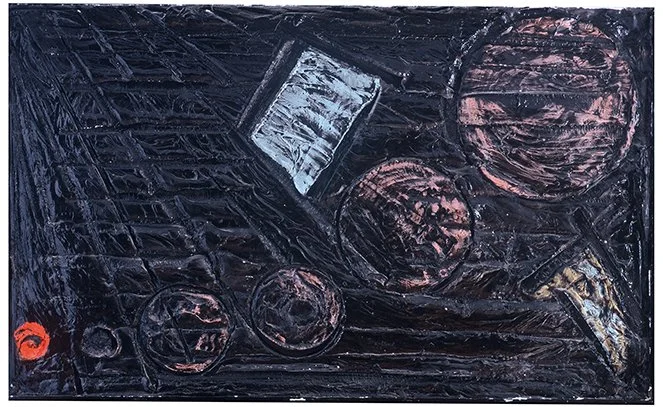
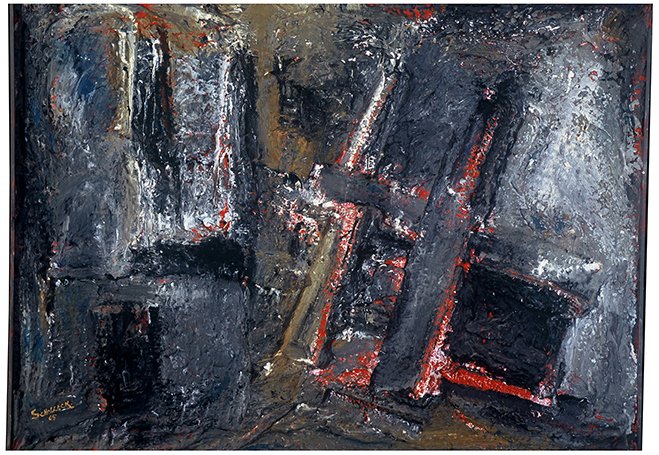
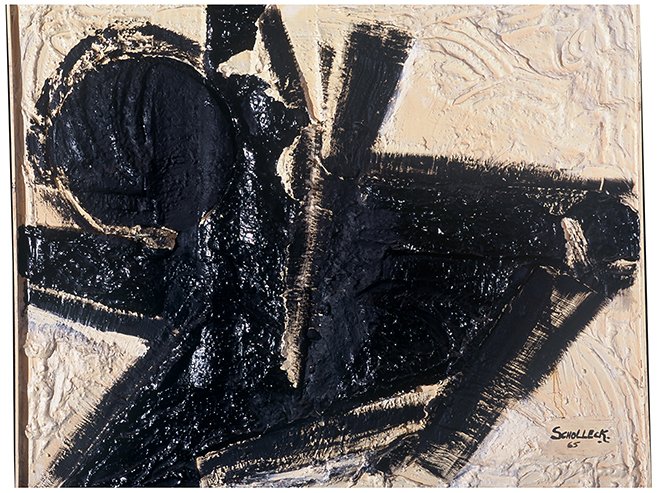
It was likely suggested to the artist through the space program taking place and in the news at that time. 1964 was significant in that it was the seventh year of the space program with a successful flight of the satellite RANGER VII, laying the groundwork for manned flight to the moon. RANGER VII took more than 4,000 images of the moon’s surface. The unmanned Gemini capsule testing was completed as well leading the way to testing procedures for manned flights in 1965.(8) Mariner 4 was launched on November 28, 1964 on a trip around Mars. It had an attached television camera documenting the surface of the planet. Space Park at the New York World’s Fair was extremely popular, and the first American astronaut walked in space on June 3, 1965. NASA released images from space which were seen on television and published in newspapers and magazines.
One painting from Scholleck’s series looks like the surface of possibly the moon but possibly Mars. It is a heavily textured, large work that initially appears to be a non-representational abstraction, but with imagery that suggests space beyond the earth. Moreover, the title of the series provides viewers with some indication of its subject. Another very large work from this group is titled Men in Space. Also thickly painted there are two abstracted, though recognizable human figures floating weightless in space. Stylistically, these works correspond to the artist’s love of texture found in many of his works. They are important paintings in which he integrates contemporary events, scientific theory, and human figures either showing them directly or positioning us as the body viewing this enormous expanse, suggesting new ways for understanding our relationship with the universe.
Scholleck continued to paint through 1967, creating some very large works before his death in 1969. A series of untitled paintings from 1966, Catalogues 117, 118, 119, and 120 share common imagery of seemingly ghostlike abstract figures floating in a compressed space. The works are very close to being nonrepresentational. Broad brushstrokes with varying textures appear on the surface while paint drips occur in other areas. These are dramatic images that reflect a new kind of expressionism that was going to arrive in the art world more generally in the 1970s and 80s—Neo Expressionism. It was a logical progression for Scholleck as he was generally oriented towards expressionism throughout his practice. These works are different for him. While he had painted on a large scale for some time, these images have a dark, disturbing psychological element that pushes against the major movements of the 1960s, Minimalism, and Conceptual art.
Scholleck was ahead of his time with this series. They also point to his constant experimentation and exploration of style and materials which began initially when he taught himself how to paint but eventually resulted in a mature practice based on an inquisitive nature and innate intelligence. In that process he naturally shifted into becoming a postmodern artist, where an idea can be expressed in different materials and methods and still represent the artist. Thus, no singular style must prevail in an artist’s oeuvre, though the subject of the body appears in many of his mature works. He had long been concerned with that topic, but overtime, as his work matured, he employed different modes of expression to examine our humanity, our relationship with the world, and at times with the universe. Often the body is within the painting, but at other times the viewer becomes the body interacting with the image.
The contrast between two late works demonstrates this. An untitled abstract image from 1966 contains melting forms, stenciled plant shapes, and a dark background that suggests outer space/the universe with rectangular areas of white that form some sort of geometric structure. We know Scholleck was interested in the physics of relativity, from his series Time, Space and Matter, but here he produces a more Surrealistic version of that topic. We see before us a window into the cosmos. Our bodies are relative to the scene. We understand there is no gravity, an idea explored both in Time, Space and Matter and in several works like the untitled abstraction discussed above (including this work and this piece).
Contrasting with these seemingly weightless images is an untitled work of 1967, a large, solidly composed painting depicting what appears to be two bodies, possibly dancing, most certainly in movement. The composition is divided by red painted lines into four main sections. These bodies are contained in the space Scholleck has created for them. Geometric forms, such as spheres and rectangles float around them. To some extent, they recall the much earlier Dancing Girls of 1954. Here paint is rapidly applied in many layers, animating the people encased within the painted surface. It is a dramatic work that again emphasizes both his expressionist approach and his continued interest in human form through an existential lens.
Finally, two of his last works to be discussed in this essay, both from 1967, Man and Woman Reclining and Bacchanal, return to subjects that connect to the history of art, the figure in context with its environment. In the first, Man and Woman Reclining, the precedent for this is likely Edouard Manet’s quite famous Le Déjeuner sur l’herbe (Luncheon on the Grass), 1863. Manet himself was engaging with the history of art, looking back to Titian’s Fête champêtre (Pastoral Concert). This is something that artists do regularly, and we have seen that Scholleck did indeed engage with works by other artists.
Scholleck’s palette of blues and greens in Man and Woman Reclining establishes an outside setting. Here the figures lean against each other and float above a cubist landscape. They recall his earlier painting, Blue Nude, in their curvilinear forms, but the brushwork is decidedly expressionist. It is quite large and very dramatic. There is obviously a close relationship between the man and woman which perhaps symbolizes Scholleck’s own marriage. When we look at the other late work, Bacchanal, we see four figures in a scene of celebration and drink. The topic, which goes back to at least ancient Rome, again links the artist to the history of art. Here the characters don’t interact with each other but seem instead to be a repeated motif placed across an abstract background. There are areas of both thick and thin paint with contrasting colors. Taken together these monumental paintings demonstrate Scholleck’s accomplishments as an artist. Had he lived longer, no doubt he would have continued to make impressive works.
ENDNOTES
(1) He did not keep records of his participation in exhibits. In a letter dated November 4, 1965, to a cousin in New York City, he wrote that he “has made practically no effort whatsoever to either sell or exhibit.” He went on to say that the few paintings he sold happened “accidentally.” He exhibited in a show in Upper Marlboro, MD in 1962 for which a curator from the Smithsonian Institution (whose name he did not recall) awarded him two prizes, first and second place for Old Man in a Wheat Field and The Fat Lady, respectively. He did submit three paintings to the Maryland Regional Exhibition, likely sometime in 1967, as indicated by identification cards on the back of each of them: Cat. 78, Jockey or DONFORDAD,Cat. 107, Time, Space and Matter, and Cat. 138, Non-Plus Ultra.
(2) When tracing the provenance of many of the works presented in ARTnews mentioned in this article, we can confirm that Scholleck learned about most of them through that publication as the paintings depicted were often being marketed by galleries and/or in private collections. Although many are in public collections today, they were not at the time they appeared in the magazine and when Scholleck was inspired by these images.
(3) A major exhibition that examined the changing Jewish perception of Jesus, Behold the Man: Jesus in Israeli Art, curated by Amitai Mendelsohntook, took place in 2016-2017 at the Israel Museum in Jerusalem. https://www.imj.org.il/node/544
(4) An exhibition (which this author saw) with catalog, Chagall: Love, War, and Exile, curated by Susan Tumarkin Goodman, was on view at the Jewish Museum in New York City in the fall of 2015. Out of 31 paintings and 22 works on paper, about 20 of them depicted Jesus.
(5) There is more recent scholarship on the tragedy too. Maria Mădălina Irimia, “Struma”: The Destiny of a Tragedy. A Revised Perspective,” translated by Bronwynn Cragg. 80 de ani de la Pogromul de la Iași și Holocaustul (Șoahul) din România, 2022. https://plural.upsc.md/wp-content/uploads/2024/08/04_Articol_IRIMIA_75-107-pag.pdf
(6) Letter to his cousin, November 4, 1965.
(7) Ibid.
(8) NASA Historical Staff, Office of Policy Planning, Astronautics and Aeronautics, 1964: Chronology on Science, Technology, and Policy, Scientific and technical Information Division, National Aeronautics and Space Administration, 1965. https://www.nasa.gov/wp-content/uploads/2023/04/1964.pdf
J. Susan Isaacs taught art history and museum studies at Towson University for over 30 years. She curated many exhibitions at TU as well as numerous institutions across the United States and abroad. She writes and publishes articles and essays on contemporary art and artists. Isaacs holds a four-year certificate of Fine Arts from the Pennsylvania Academy of the Fine Arts in painting, B.A., M.A., Ph.D. degrees in art history from the University of Delaware, and an M.F.A. in studio art from Towson University. Her own artwork can be seen on her website http://www.susanisaacs.art
©